
Restaurant Marketing in Orlando: Why Direct Orders and Local SEO Matter More Than Ever
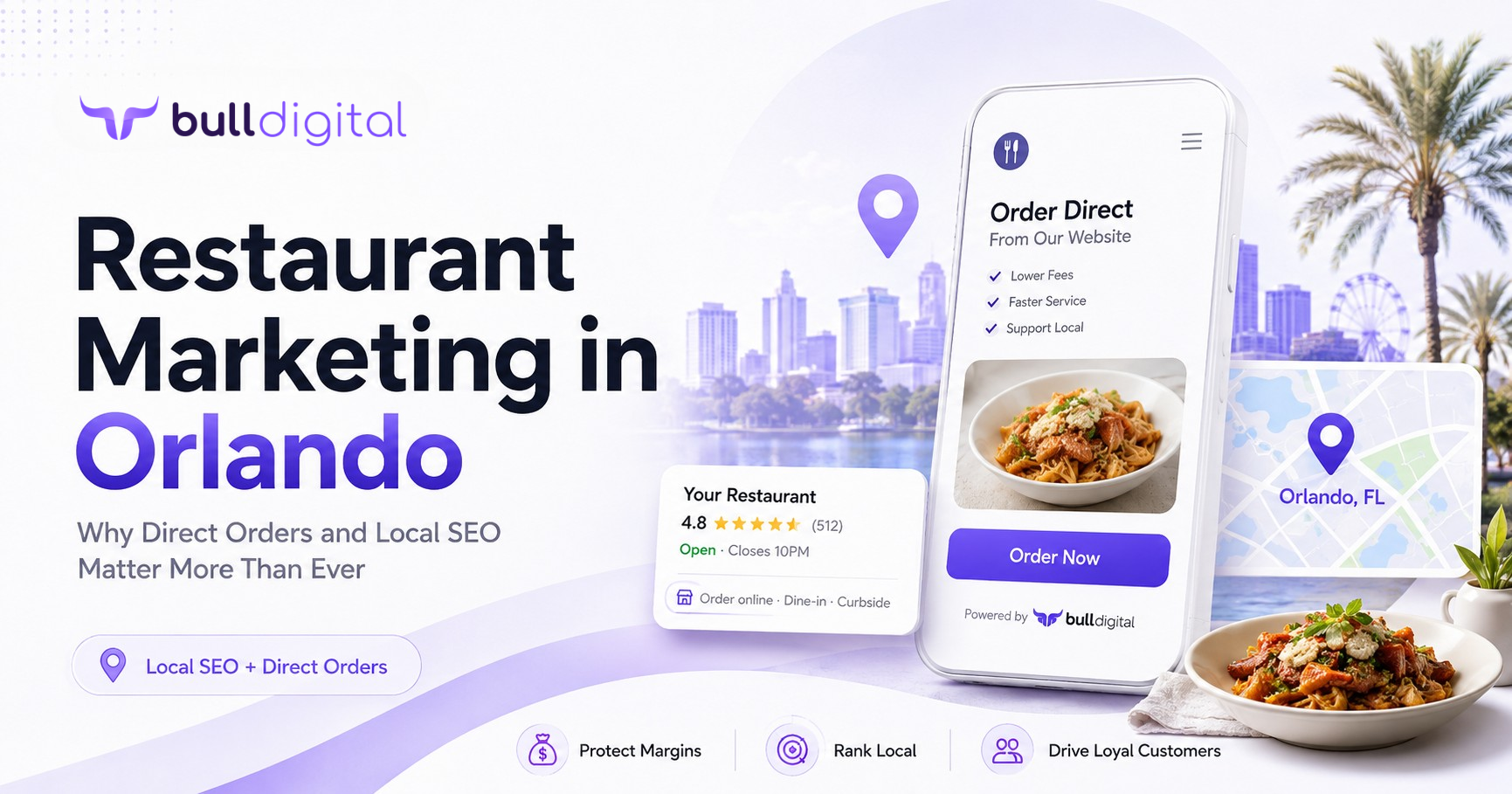
For restaurant owners in Orlando, the digital battlefield has shifted. The challenge is no longer just about driving volume or stacking up online orders.
The real challenge is ownership. Who owns the customer relationship? Where is the demand actually coming from? And crucially—how much margin is left on the table after every transaction?
In a hyper-competitive culinary landscape like Orlando, sheer visibility is no longer enough. Most restaurants are already listed on major platforms, running social media ads, and receiving a steady stream of digital orders. Yet, a massive portion of their hard-earned revenue is being siphoned away by third-party channels that demand exorbitant commissions, hide valuable customer data, and hold long-term loyalty hostage.
The Shift: Modern restaurant marketing must transition from basic advertising to a strategic growth infrastructure.
To thrive today, Orlando restaurants—especially those competing for high-intent local searches like "restaurants near me," "Brazilian steakhouse Orlando," or "best dinner in Orlando"—must optimize every touchpoint. You need to become easier to find, easier to trust, and seamless to order from directly.
The Hidden Cost of Third-Party Delivery Apps
Third-party delivery platforms are a double-edged sword. While they offer undeniable convenience and instant exposure to a built-in audience, they introduce a compounding margin problem.
Many owners fall into the trap of relying entirely on these apps, ignoring the hidden erosion of their business value:
- Aggressive Commission Fees: Chipping away at already tight restaurant margins.
- Loss of Experience Control: The delivery experience is outsourced, leaving your brand vulnerable to third-party mistakes.
- Zero Customer Data Access: The platform gets the order, but the platform owns the customer.
When you don't know who is eating your food, you cannot market to them. You cannot send personalized offers, celebrate their birthdays, or incentivize a second visit. This creates a vicious cycle: your order volume grows, but your dependent relationship with third-party apps deepens.
The goal isn't necessarily to abandon delivery apps entirely. The goal is to build an independent alternative. A sophisticated restaurant marketing strategy uses organic local discovery to guide customers straight to your website, protecting your margins and building an owned audience.
Shifting From Paid Ads to Predictable Systems
For years, "marketing" for restaurants meant running occasional promotions, posting food photos, or offering steep discounts. Today, that approach is unsustainable. Instead of asking, "How do we get more orders tomorrow?" forward-thinking operators are asking:
"How do we build a system that predictably generates highly profitable orders over time?"
An optimized digital ecosystem relies on four pillars:
[Visibility] ➔ [Positioning] ➔ [Conversion] ➔ [Retention]
In Orlando, where a mix of global tourists and local residents rely heavily on search engines to make dining decisions, local search intent is incredibly lucrative. When someone opens Google to find food, they are ready to buy. They look at reviews, browse photos, check the menu, and make a decision within seconds.
If your website isn't optimized for friction-free direct ordering, or your Google Business Profile is neglected, you are actively handing profitable revenue to your competitors.
Capturing High-Intent Demand with Local SEO
Local SEO is the single highest-ROI growth lever available to local restaurants. It positions your brand exactly where the demand is already happening.
When optimized correctly, Local SEO targets specific, high-value keyword clusters in the Orlando market:
Target Search Clusters for Orlando Restaurants
Keyword CategorySearch ExamplesCuisine & Concept "Brazilian restaurant in Orlando", "Authentic steakhouse Orlando" Location & Geo-targeted "Best dinner near International Drive", "Lunch near me" Intent & Experience "Family restaurant Orlando", "Direct online ordering restaurant"
Achieving top visibility in Google’s Local Pack requires a comprehensive strategy: comprehensive Google Business Profile management, structured local citations, menu schema optimization, and localized content that signals authority to search algorithms.
Trust, Friction, and the Digital Storefront
Visibility gets you noticed; trust and user experience get you paid. Once a customer discovers your restaurant, two critical factors dictate whether they order directly or open a third-party app:
1. Reputation Architecture (Reviews)
Reviews are the social proof that validates your pricing and quality. Active review acquisition and management are foundational to converting casual searchers into hungry customers.
2. The Frictionless Website Experience
Too many restaurants lose direct revenue because of slow, outdated, or confusing mobile websites. If a customer has to download a massive PDF menu or click through multiple broken links to order, they will leave.
- Your website is your digital storefront. It must be engineered for conversion with clear call-to-actions (CTAs), an intuitive mobile menu, and an integrated, secure direct ordering system.
Turning Traffic into Owned Customer Data
The ultimate competitive advantage in modern food-and-beverage marketing is owned data.
When a customer orders directly through your platform, they are giving you permission to build a relationship. This data powers your long-term retention engine:
- Automated Email & SMS Marketing: Target past guests with weekend specials or exclusive menu drops.
- Automated Reactivation Flows: Win back customers who haven't ordered in 30 days.
- Loyalty & Birthday Campaigns: Increase lifetime value (LTV) without paying a dime in acquisition costs.
Traffic has limitations, but an owned database creates predictable, compounding revenue.
Action Plan for Orlando Restaurant Owners
To audit your current digital position and determine if you are set up for profitable growth, ask yourself these diagnostic questions:
- [ ] Does your restaurant dominate the Google Local Pack for your specific cuisine in your geographic radius?
- [ ] Is your Google Business Profile fully optimized with high-conversion images and updated menus?
- [ ] Does your website allow a customer to place an order in under 3 clicks?
- [ ] Do you have an active strategy to convert third-party app users into direct website buyers?
- [ ] Are you systematically capturing data to drive repeat visits?
In Orlando’s fast-paced hospitality market, staying passive is a risk. Restaurants must move past just "having a website" and step into strategic digital positioning.
Ready to Uncover the Hidden Revenue in Your Digital Presence?
At Bull Digital, we bridge the gap between marketing, local SEO, and data architecture to help hospitality brands maximize their direct orders and defend their bottom line.
Frequently Asked Questions
What is modern restaurant marketing?
It is a comprehensive strategy engineered to attract, convert, and retain guests. Beyond traditional advertising, it integrates local SEO, website performance optimization, review acquisition, direct online ordering infrastructure, and data-driven loyalty marketing.
Why is local SEO vital for restaurants in Orlando?
Orlando’s unique market blend of high-volume tourism and dense local neighborhoods means thousands of high-intent searches occur daily. Ranking for terms like "restaurants near me" or "best dinner in Orlando" allows you to capture customers at the exact moment they are deciding where to eat.
How does local SEO drive direct orders?
By capturing organic search traffic on Google and routing those users directly to your proprietary website and ordering engine, rather than allowing third-party marketplace apps to intercept the lead.
Should my restaurant stop using platforms like UberEats or DoorDash?
Not necessarily. Third-party apps are highly effective top-of-funnel awareness tools. However, they should serve as an acquisition channel to introduce users to your food—after which your marketing system should convert them into direct, loyal buyers.
How exactly do third-party delivery apps impact my margins?
They charge steep commission fees (often between 15% to 30% per order) and withhold customer contact information, preventing you from marketing to that customer again without paying for the platform’s real estate.
What are the core components of a high-converting restaurant website?
A mobile-first layout, an interactive (non-PDF) menu, prominent "Order Direct" buttons, integrated reservation tools, clear location/hours, embedded social proof, and lightning-fast load times.
What is "owned customer data" for a restaurant?
It is actionable guest information (names, emails, phone numbers, order history) collected directly through your website, loyalty program, or reservation system. It allows you to run commission-free marketing campaigns directly to your best clients.
How does Bull Digital help Orlando restaurants scale profitably?
Bull Digital designs and executes custom growth frameworks—combining advanced local SEO, conversion-optimized websites, and data retention tactics—to reduce third-party app reliance, elevate brand visibility, and aggressively protect your profit margins.