
ChatGPT Ads in Brazil: How Advertising Within Artificial Intelligence Can Transform Paid Media

ChatGPT Ads in Brazil: How Advertising Within AI Can Transform Paid Media
The way people search the internet is changing, and digital advertising is beginning to keep pace with this transformation.
For years, much of the digital acquisition strategy was concentrated on search engines and social networks. Google Ads, Meta Ads, and LinkedIn Ads established themselves as vital paid media channels for companies looking to generate traffic, leads, and business opportunities.
Now, a new front is gaining relevance: ads within conversational artificial intelligence experiences.
OpenAI is expanding ChatGPT Ads, its advertising platform integrated into ChatGPT. The project began testing in the United States, and in May 2026, the company announced the expansion of the pilot to other markets, including Brazil.
For companies and marketing professionals, this represents more than just the emergence of a new ad platform.
We are witnessing a shift in the very logic of digital media.
At Bull Digital, we are already working with this new front and studying how to integrate ChatGPT Ads, paid media, GEO, SEO, AI, and data within acquisition and growth strategies.
What is ChatGPT Ads?
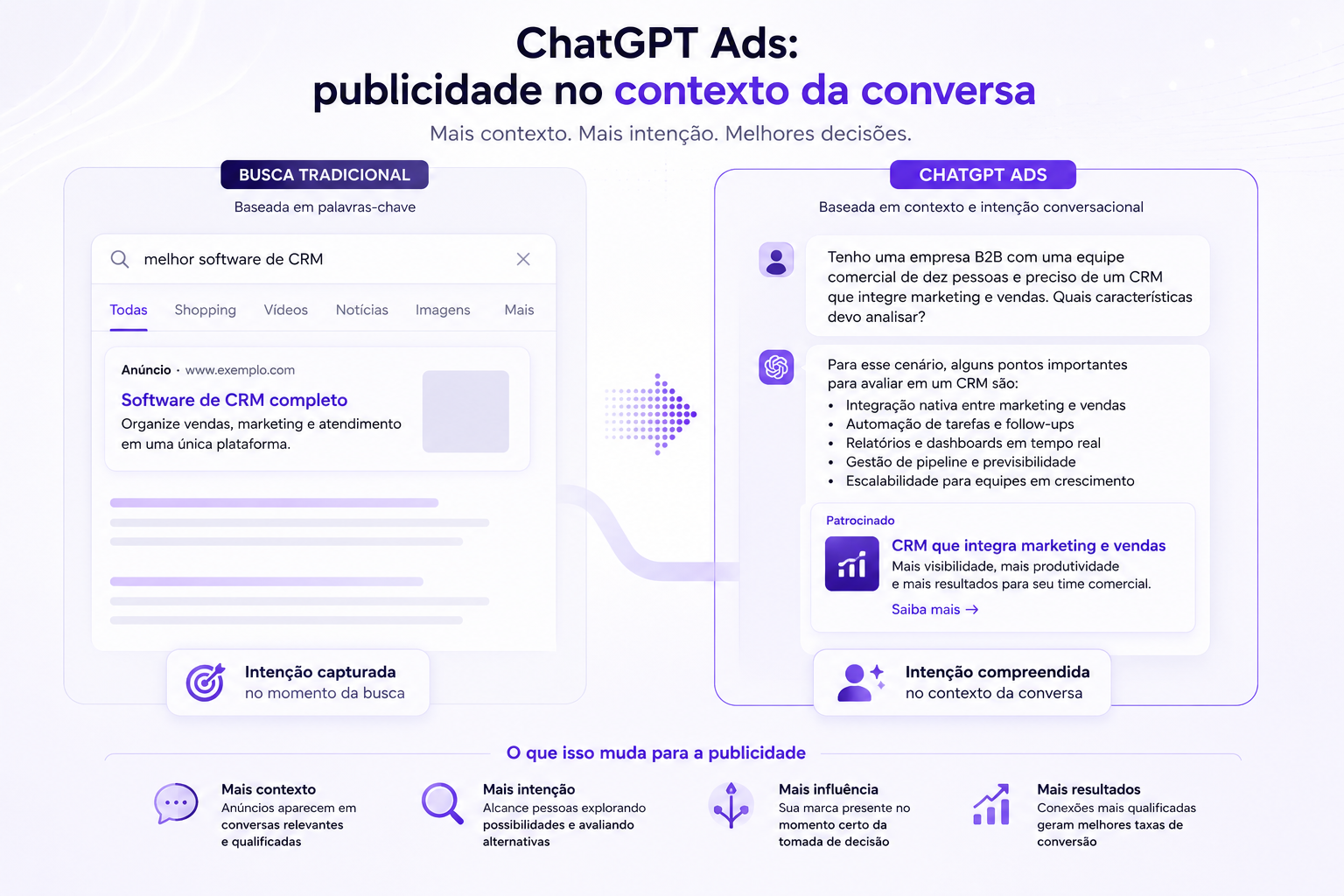
ChatGPT Ads is OpenAI's advertising solution that allows companies to appear via sponsored content within the ChatGPT experience.
The difference lies primarily in the context.
On a traditional search engine, a person might search for:
“best CRM software”
In a conversational platform, that same intent might appear in a much more detailed way:
“I have a B2B company with a sales team of ten people and I need a CRM that integrates marketing and sales. What features should I analyze?”
This contextual richness creates a different dynamic for advertising.
According to OpenAI itself, ChatGPT ads were developed to reach people while they explore possibilities, compare alternatives, and make decisions within a conversational experience.
In other words: we are moving from an environment predominantly based on keywords to one where conversational context and intent gain importance.
How do ads work in ChatGPT?
Ads appear separate from ChatGPT's organic responses and are clearly identified as advertising. OpenAI states that advertisers cannot alter, influence, or purchase positions within the responses generated by the model.
Currently, an ad can include elements such as the advertiser's name, logo, headline, description, landing page, and image.
For advertisers, the structure is beginning to align with familiar elements of the performance market.
The OpenAI Ads Manager Beta allows for the configuration of campaigns, budgets, objectives, ad groups, creatives, and performance tracking. Current documentation also features buying and optimization models such as CPM, CPC, and conversion-optimized campaigns.
Available reports include metrics such as impressions, clicks, spend, CTR, average CPC, average CPM, and conversions.
Therefore, although we are facing a new media environment, fundamental concepts of performance marketing and results measurement remain present.
Why ChatGPT Ads could change paid media?

The great transformation isn't just in the ad format.
It's in the moment the brand can appear.
On Google, there is typically a query.
On social media, there is a content consumption context.
Within a conversational AI, there is something potentially even richer: a conversation about a need.
Imagine a company researching how to reduce its customer acquisition cost.
Before looking for an agency, its executive might ask an AI:
“How to lower my CAC?”
Then:
“Does SEO or paid media work better for B2B companies?”
Next:
“How much should a company invest in Google Ads?”
And finally:
“What type of agency can integrate paid media, SEO, and AI?”
There is a journey happening within the conversation.
This transforms the discussion about advertising because the goal is no longer simply to buy a keyword.
It becomes about understanding context, necessity, intent, and the moment of decision.
Does ChatGPT Ads replace Google Ads or Meta Ads?
We don't see it that way.
The most likely scenario is the construction of a more complex acquisition ecosystem.
Google Ads remains extremely relevant for capturing existing demand.
Meta Ads has an enormous capacity for demand generation, discovery, and reach.
LinkedIn Ads remains strategic for specific B2B audiences.
And conversational platforms start to create a new layer within this journey.
That’s why a modern paid media strategy can involve different channels working together:
Google Ads + Meta Ads + LinkedIn Ads + ChatGPT Ads + SEO + GEO + content + data.
The question is no longer “which platform will replace the other?” and becomes:
how to build a presence across all relevant points of the decision journey?
What is the relationship between ChatGPT Ads, SEO, and GEO?

There is an important distinction here.
Advertising on ChatGPT and organic presence in AI responses are not the same thing.
ChatGPT Ads involves paid media.
Meanwhile, GEO — Generative Engine Optimization — works on strategies to increase the understanding, relevance, authority, and presence of brands and content in search and discovery environments mediated by artificial intelligence.
This is exactly why the two strategies can be complementary.
A company can work simultaneously on:
strategic content, technical SEO, digital authority, semantic clusters, brand presence, GEO, and paid media.
This integration increases the company's touchpoints with its market.
In practice, we are moving from a vision based solely on ranking to a strategy based on contextual digital presence.
What changes in content strategy?
A lot.
OpenAI's own documentation explains that creating ads for ChatGPT requires a different approach than keyword-only platforms. Among the signals considered is conversational intent, and the recommendation for advertisers is to work with clear, specific messages oriented toward the benefit offered.
This logic directly aligns with a good GEO strategy.
A brand needs to make clear:
what it does, who it does it for, what problem it solves, what solutions it offers, and why it has authority on that subject.
This also explains the importance of keyword and entity clustering.
Instead of repeating a word like “paid media” in isolation, a more complete strategy builds a semantic universe involving related terms:
paid media, paid traffic management, Google Ads, Meta Ads, LinkedIn Ads, ChatGPT Ads, digital advertising, artificial intelligence, performance marketing, demand generation, qualified leads, conversion, CAC, ROI, ROAS, SEO, GEO, and data.
Thus, search engines and AI systems receive more context about that company's expertise.
Bull Digital is already working with ChatGPT Ads
 Bull Digital AI strategy" loading="lazy" style="width: 100%; height: auto; display: block; border-radius: 12px;">
For Bull, keeping up with this transformation is part of a larger vision for marketing.
We don't see ChatGPT Ads as an isolated action.
We are working this new possibility in connection with the ecosystem of paid media, GEO, SEO, content, technology, AI, and data.
Because consumer behavior has already changed.
People search on Google.
They discover brands on social media.
They compare companies.
They read reviews.
They watch content.
And increasingly, they ask artificial intelligence questions before making decisions.
If the journey is changing, the marketing strategy must change as well.
The future of media is conversational
ChatGPT Ads is still in beta, and its platform continues to evolve. OpenAI describes the product as being in the early stages of expansion, with new buying, measurement, and optimization features being developed.
Therefore, this is exactly the time to learn.
It doesn't mean abandoning consolidated strategies.
It means adding a new layer to acquisition planning.
The next generation of digital marketing will likely not be defined exclusively by SEO or paid media, Google or ChatGPT, search or AI.
It will be defined by companies' ability to connect these environments.
At Bull Digital, we believe that marketing + technology + data need to work together to turn behavioral shifts into real business opportunities.
And conversational media has just opened a new one.
Is your company prepared to appear when your next client asks an AI what to do?
FAQ: Frequently Asked Questions about ChatGPT Ads
What is ChatGPT Ads?
ChatGPT Ads is OpenAI's advertising platform that allows companies to display ads within the ChatGPT experience. Ads are identified as sponsored content and appear separately from responses generated by the AI.
Is ChatGPT Ads available in Brazil?
Yes. OpenAI expanded its ChatGPT ad testing to Brazil in 2026. The platform is still evolving, with campaign creation, targeting, measurement, and optimization features being developed and expanded.
How to advertise on ChatGPT?
Campaign management can be performed through the OpenAI Ads Manager for eligible advertisers. The structure allows for the configuration of campaigns, objectives, budget, ad groups, creatives, and performance metrics tracking.
How much does it cost to advertise on ChatGPT?
Investment can vary according to the buying model, campaign, audience, and strategy used. The platform already works with metrics and models known to the digital media market, such as CPC (cost per click), CPM (cost per thousand impressions), CTR, and conversions.
How does ChatGPT Ads targeting work?
Advertising within ChatGPT adds an especially important variable: conversational context. This allows for targeting based on the intent demonstrated by the user during their interaction with the AI, in addition to other criteria available for each campaign.
Does ChatGPT Ads replace Google Ads?
No. ChatGPT Ads should be understood as a new layer within a paid media strategy. Google Ads remains extremely relevant for capturing demand, while platforms like Meta Ads, LinkedIn Ads, and ChatGPT Ads can act at different moments of the consumer journey.
A performance strategy can combine different channels according to business objectives.
What is the difference between ChatGPT Ads and GEO?
ChatGPT Ads is paid media. GEO (Generative Engine Optimization) is an optimization strategy for generative engines.
In ChatGPT Ads, a company pays to display advertising.
In GEO, the goal is to increase brand relevance, authority, understanding, and presence in AI-mediated environments through content, entities, semantic context, digital authority, and other signals.
They are different but complementary strategies.
Does ChatGPT Ads influence ChatGPT's responses?
No. According to OpenAI, ads are separate from responses, and advertisers cannot buy or modify the responses generated by ChatGPT.
This makes it even more important to differentiate two strategies: sponsored presence through ChatGPT Ads and organic presence worked through SEO, GEO, content, and digital authority.
What is conversational media?
Conversational media is a new advertising dynamic where the communication opportunity arises within conversation-based experiences, especially AI platforms.
Instead of considering only a keyword or audience profile, the strategy can take into account the context and intent demonstrated during a conversation.
Can B2B companies advertise on ChatGPT?
ChatGPT Ads can create interesting opportunities for B2B companies because many users use AI to research solutions, understand problems, compare alternatives, and support professional decisions.
For B2B businesses, this can represent a new touchpoint during the buyer's journey.
How to prepare a company for ChatGPT Ads and AI search?
Preparation should not involve paid media alone. A more complete strategy can integrate ChatGPT Ads, GEO, SEO, strategic content, brand authority, data, CRO, and performance marketing.
It is also important to structure content that clearly explains who the company is, what solutions it offers, what problems it solves, which audiences it serves, and its competitive differentiators.
Does Bull Digital work with ChatGPT Ads?
Yes. Bull Digital is already working with ChatGPT Ads and following the evolution of this new media channel.
Bull's strategy connects ChatGPT Ads, paid media, GEO, SEO, AI, content, technology, and data, aiming to turn new search and discovery behaviors into real business opportunities.
Is your company prepared for the new era of search?
The digital journey is no longer happening only on search engines and social networks.
Now, your potential clients also ask, converse, compare, and make decisions using artificial intelligence.
Bull is already working to connect brands to this new behavior.
Want to understand how ChatGPT Ads, GEO, SEO, and paid media can be part of your company's strategy? Speak with Bull Digital.